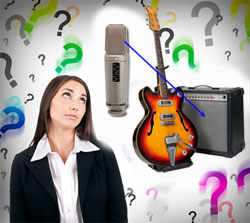
 Someone sent me a question this morning after listening to the audio samples (of both acoustic guitar and voice-over vocal) in my review of the Audio-Technica AT2035 large diaphragm condenser microphone here: https://www.homebrewaudio.com/review-of-the-audio-technica-at2035-microphone/. In that review, I compare the AT2035 with the Rode NT2-A.
I thought I’d share his question and my answer.
Here is his question:
I was looking at your review of the AT2035 and i noticed an emphasis on the mid range. The Rode NT2-A mic sounds better to me.
 Now, I’m looking for a microphone that i can record my electric guitar ( loud volumes but not blistering loud) my voice, and my acoustic guitar. So I was wondering – can I record my electric guitar with the Rode mic that you demoed in the video?
Thanks!
Here is my answer:
Yes the Rode NT2a is definitely the better mic no question. And you can also get great results using it to record voice, acoustic and electric guitar. However, it is VERY important that you understand something about using a large diaphragm condenser to record an electric guitar amp. These mics are VERY sensitive so you’d need to make sure your amp’s volume is low enough when you record. You can still get great “big” sound with the amp volume turned down. Once it’s recorded, then crank it up in the mix. But if it’s too loud when recording you could damage the mic and/or clip your recording levels. Since the NT2-A has a pad switch, I recommend setting it to -10 dB.
Hope that helps!
Ken
 One of my readers sent me an e-mail that asked the following:
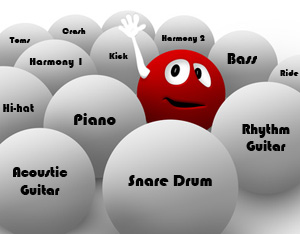 I am always saying that knowledge trumps gear. It’s actually our motto at HBA. One of the many reasons for that is how easy it is to make a recording that sounds bad even with the most expensive gear. And one of the things I hear done incorrectly most often is mixing the lead vocal with the rest of the instruments in a song. It is very easy to make the vocal stand out too much or allow it to be overpowered by those instruments. Creating space for the lead vocal so that it can be properly heard and understood while simultaneously allowing the drums, guitars, bass, piano, etc. to be head as well can be quite a trick.
 If you’re a musician doing home music recording, then you probably want to know about something called “MIDI” (pronounced middee) if you don’t already. So this article ought to be useful. But I have discovered that it is well-nigh impossible to know everything about anything. This was a great stress-relieving discovery! I always felt a little like I was somehow just toying around with something if I didn’t understand everything about it, including the origin, underlying code, every possible use, etc. But not knowing how an engine works never stopped me driving a car. Not knowing how to build a television from scratch does not make me feel unworthy to use a TV. So it is with MIDI, and most things in the music and audio recording world. You only need to know what you need to know to get the things done you need to get done. That last sentence is both profound and confusing at the same time, but it is truth! Once you accept it, your stress levels may well drop. Mine did.
 You can have your MIDI file play any instrument on your sound card. For example, if you have a MIDI file of “Mary Had a Little Lamb,” it might be set to play the piano instrument on your computer. You can then switch and hear the song playing on, say, and accordion, or a fiddle. Now these sound card instruments are frequently pretty cheesy sounding. Things really start to get interesting when you procure “