I just found out about some killer home recording studio bundles now available from B&H Pro Audio. Both use the Rode NT1-A large diaphragm condenser microphone, which is one of the most amazing vocal mics on the market for recording your voice. And both of these bundles fall into my home studio classification of “configuration 2,” which means they are standard XLR microphones that get plugged into an audio interface, which in turn gets plugged into a computer, via USB in this case.
Mbox Mini Vocal Studio
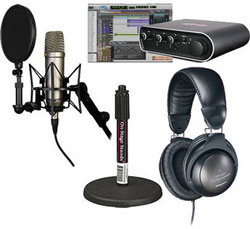
The Avid Mbox Mini Vocal Studio (the “mini” is for the product called the Mbox Mini) consists of the awesome Rode NT1-A large diaphragm condenser mic, along with the Rode shock mount and integrated pop-filter and 20-ft. mic cable; the Avid Mbox Mini audio interface with ProTools Express recording software; Audio-Technica ATH-M20 Closed-Back Headphones, and the On-Stage Round Base Desktop Microphone Stand.
This is no-kidding professional stuff for anyone recording voice-overs, podcasts, or 1-man-band music, or doing Skype calls, webinars, etc.
If you were to buy each item separately it would cost $517.31. But for the bundle, the price is: $459.95! CLICK HERE for more details and/or to buy.
MBox Mini Vocal Studio + Pro Tools 10 + Studio Monitors
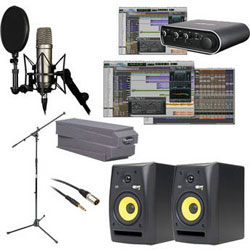
This package starts with the same contents as the one above, but then cranks up the “awesome” by using the full version of the audio recording industry standard Pro Tools 10, a pair of KRK RoKit 45W 5″ active monitor speakers, a full-size microphone boom stand, 2 mic cables, and a set of Auralex MoPAD Isolation Pads for the monitors.
This version of the package gives you all you need to rock-solid professional voice-over work, but also to record vocals and instruments, add virtual drums and other instruments with Pro Tools, and produce professional sounding multitrack music projects as well.
This would cost $1,450.70 if each item were bought separately.The cost for this one is $1,039.50. You save $411! CLICK HERE for more details and/or to buy.
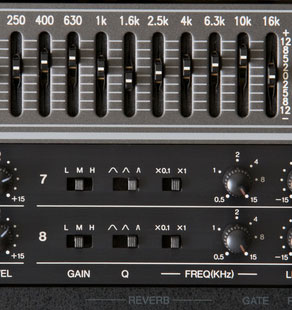 I’ve been writing a lot about EQ this past week – starting with a basic explanation of frequencies and equalization in
  You’ve heard it before. It’s a common effect on lead vocals in pop music and has been for many year. I’m referring to the effect that makes the vocal sound like it’s coming through a telephone line. In fact, when I think of this effect the first song that pops into my head is the song by ELO called, interestingly enough,
 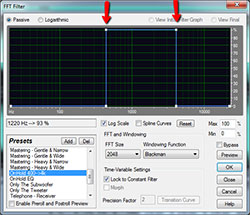 The way this is achieved is by severely limiting the frequencies that are audible on the target track to a very narrow range in the “mids” – between about 400 Hz and 4 KHz. See the picture on the right. You can use an EQ for this, or you can use frequency filters like the one in the picture in
 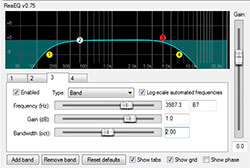 In
In 
 When a vocal recording sounds muffled, like the singer/speaker has a box over his/her head, that’s usually NOT what we want. So what do we do about muffled vocals? In other words, how do we improve voice clarity?
 Equalization, or EQ for short, is a fundamental concept in audio recording, live sound, or simply listening to audio. For a primer on what it is, see our article